

To protect your floors from winter salt in Washington, DC and Montgomery County, stop it at the door with an outdoor scraper mat and an indoor absorbent mat, take shoes off at the entry, vacuum dry salt grit before you mop, and then wipe the white residue away with a damp mop and a cleaner made for your floor type. The order matters, because mopping before vacuuming drags abrasive grit across the finish, and salt left to sit keeps pulling moisture into wood, grout, and carpet.
Below is why homes in the District and the Maryland suburbs bring in so much salt every winter, what it does to each kind of floor, a simple entryway plan, how to clean the residue without making it worse, and where a professional clean fits in. It is general guidance, so always check your flooring manufacturer’s care instructions first.
Family-owned · Employees, not contractors · Licensed, bonded & insured · Background-checked · Pet-friendly · 100% satisfaction guarantee · five-star Google reviews
Why DC-area homes track in so much salt
Salt season here starts before the snow does. The District’s snow team typically applies brine, a mix of salt and water, to streets 48 to 72 hours before precipitation begins, and it encourages residents to put rock salt, de-icer, or non-clumping kitty litter on the sidewalks around their homes. DC property owners also have to clear their sidewalks within eight daylight hours after a storm ends.
Montgomery County runs on the same pattern. Property owners there are required to clear sidewalks in front of and alongside their homes within 24 hours of the end of a storm, so nearly every walkway, stoop, and driveway gets shoveled and salted at once.
The result is that your floors deal with two things, not one. There is the slush that melts on the mat during the storm, and there is the dry salt and grit that stays on sidewalks for days afterward and keeps coming in on boots, stroller wheels, and paws long after the snow is gone. That second wave is the one most people stop watching for.
What salt and slush do to each type of floor
Salt works against floors in two ways: the crystals are abrasive under foot traffic, and the residue holds moisture against the surface. How that shows up depends on the floor.
| Floor type | What winter salt does | How to clean it |
| Hardwood | Leaves a white film, dulls and scratches the finish, and lets moisture reach the seams if slush sits | Vacuum dry grit first, then a barely damp mop with a wood-safe cleaner; dry right away |
| Luxury vinyl and laminate | Hazy white streaks and fine scratches near the door | Vacuum, then damp mop with a cleaner your manufacturer approves; never flood the seams |
| Ceramic and porcelain tile | White haze on tile and salt crust settling into grout lines | Vacuum, then mop with clean water and a neutral cleaner; give grout lines a soft brush |
| Marble and natural stone | Residue and scratching, and acidic home remedies can etch the surface | Vacuum, then a stone-safe neutral cleaner only; no vinegar or lemon |
| Carpet and rugs | Salt crystals wear fibers and leave white rings that keep attracting moisture | Let dry fully, vacuum slowly in both directions, then blot remaining rings with warm water |
Stop it at the door: an entryway plan that works
Most of the damage is preventable before it crosses the threshold. A good winter entry setup looks like this:
- Use two mats, not one. A coarse scraper mat outside knocks off snow and grit, and an absorbent mat inside catches the moisture before it reaches the floor.
- Add a boot tray and make the entry a shoes-off zone. Winter boots carry the most salt in their treads, and a tray keeps the melt off your floor.
- Wipe paws at the door. Dogs bring in as much salt as people, and Montgomery County’s own guidance notes that de-icing salt can harm pets, so a towel by the door does double duty.
- Use less salt on your own steps. Montgomery County’s Salt-Wise guidance says a 12-ounce mug of salt is enough for a 20-foot driveway or 10 sidewalk squares, recommends shoveling before snow turns to ice, and suggests sweeping up leftover salt to reuse. Less salt on your stoop is less salt on your floors.
- Wash and dry your mats. A mat that stays soaked or crusted with salt stops working, and a damp mat left on hardwood can cause its own moisture damage.
How to clean salt residue without making it worse
When the white film shows up, the sequence is what protects the finish:
- Blot standing slush first. Soak up puddles with a towel instead of spreading them with a mop.
- Let it dry, then vacuum. Dry salt crystals are abrasive, so pull them up with a vacuum on the hard-floor setting before any mop touches the floor.
- Damp mop with the right cleaner. Use a cleaner made for your floor type, with the mop wrung out well, so you dissolve the film without soaking wood or seams.
- Rinse and dry. A pass with clean water and a dry microfiber cloth keeps the residue from reappearing as streaks.
- Check the baseboards and the lower walls. Slush splashes, and the bottom of the entry walls and door frames collect the same white residue as the floor.
One common shortcut to avoid: vinegar is often suggested for salt stains, but it is acidic and can etch marble and other natural stone, and many hardwood finish makers advise against it. When in doubt, follow the care guide for your specific floor.

Our trained, uniformed team on a job in the DC & Montgomery County area.
Rowhouse, condo, or house with a garage: where salt gets in
Where the salt comes in depends on the kind of home you have, and so does the fix.
In a Washington, DC rowhouse, the front door often opens straight from the stoop into a hallway or living room, frequently with older hardwood and original trim right at the entry. There is little room for a mudroom, so the two-mat setup and a boot tray matter more here than anywhere else, and the stairs carry the salt to every floor.
In apartment and condo buildings in Bethesda and Silver Spring, the lobby mats catch some of it, but salt from the sidewalk and the parking garage still rides up the elevator on your shoes. Your own door mat is the last line of defense before the unit’s floors.
In single-family homes across Rockville and the rest of the county, the main entry in winter is often the garage or a side door, not the front. Salt drips off the car and gets carried in from the driveway, so that is the door that needs the mats, the tray, and the most attention.
Where a professional clean fits in winter
Winter is when floors take the most abuse and when it is hardest to keep up, especially with the holidays in the middle of it. A recurring cleaning plan keeps the grit from building up: each visit includes vacuuming and mopping the floors, vacuuming the stairs, and dusting baseboards, which pulls salt out before foot traffic grinds it into the finish.
When the thaw finally comes, a deep clean resets what a season of salt left behind, with baseboards, moldings, doors, and door frames hand-washed instead of just dusted. If you are getting ready to host, our guide to getting your home guest-ready for the holidays covers the rest of the house.
Our products and team are pet-friendly, so the cleaning itself is safe for the same pets coming in from salted sidewalks. And every clean is backed by a 100% satisfaction guarantee: if something is not right, let us know within 24 hours and we will send a team back to make it right, at no additional cost.
What our DC-area clients say
We have earned five-star reviews on Google from homeowners and renters across DC and Montgomery County. A couple of them:
“Cris’ Cleaning Squad is absolutely the best! Kerturly and Denise are incredible and truly the best we’ve ever had. Every single time they clean our home, I’m amazed by how wonderful everything looks. Their work is consistently excellent, and I couldn’t be happier.”
— Erica C. · Recurring client
“Cris and her team are unbelievable! Their attention to detail was unmatched, my home has never looked cleaner. Highly recommend Cris Cleaning for their exceptional service and communication. 5 stars!”
— Phoebe B. · Attention to detail
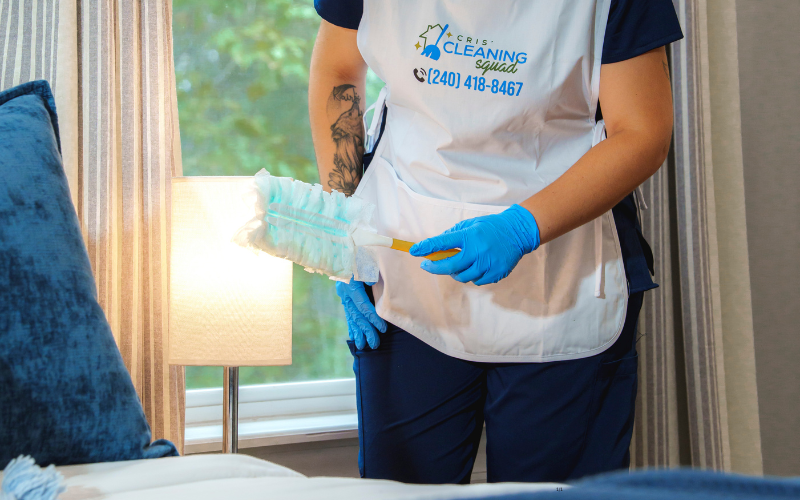
One of our uniformed cleaners during a home visit in the Montgomery County area.
Keep winter salt from wearing down your floors. Serving Washington, DC, Rockville, Bethesda & Silver Spring. Call (240) 418-8467 or get your free estimate online.
Frequently asked questions
How do you get salt stains off hardwood floors?
Let any slush dry, vacuum up the loose salt grit on the hard-floor setting, then wipe the white film with a well-wrung damp mop and a cleaner made for wood floors. Finish by drying the area with a microfiber cloth. Vacuuming first matters, because mopping over dry salt drags abrasive grit across the finish.
Can road salt damage hardwood floors?
Yes. Salt crystals scratch and dull the finish under foot traffic, and the residue holds moisture against the wood and its seams. Left in place through a whole winter, that can wear through the finish near entries. Mats, a shoes-off entry, and prompt cleaning prevent most of it.
Is it safe to use vinegar to remove salt from floors?
Not on every floor. Vinegar is acidic and can etch marble and other natural stone, and many hardwood finish makers advise against it. A neutral cleaner made for your floor type is the safer choice, and your flooring manufacturer’s care guide is the final word.
How do I keep salt from being tracked into my house?
Use a coarse scraper mat outside and an absorbent mat inside, keep a boot tray by the door, make the entry a shoes-off zone, and wipe pets’ paws when they come in. Using less salt on your own steps and sweeping up the leftovers also cuts down what comes inside.
How much salt should I use on my sidewalk in Montgomery County?
Montgomery County’s Salt-Wise guidance says a 12-ounce mug of salt is enough for a 20-foot driveway or 10 sidewalk squares. It also recommends shoveling before snow turns to ice and sweeping up leftover salt to reuse, which protects local waterways and your floors.
When should I schedule a deep clean after winter?
Once the snow is done and the sidewalks have been swept clear of salt, usually as the weather warms. Cleaning before then means the next storm brings the residue right back. A deep clean at that point resets baseboards, door frames, and entry floors that took a season of salt.

Fatima Cristina is the founder and owner of Cris’ Cleaning Squad, a family-owned cleaning company serving Washington, DC, Bethesda, Rockville, and Silver Spring. With over a decade of hands-on experience in professional cleaning, she built the company on trained, insured, and background-checked cleaners and a 100% satisfaction guarantee. Her team has cleaned 500+ homes across the DC and Maryland area and runs the Cleaning for a Reason program, offering free cleanings to patients battling cancer in the region.
Floor care tips on this page are general guidance. Always follow your flooring manufacturer’s care instructions. For an exact price on a recurring or deep clean, request a quote.